

Lost motion doesn’t have to be permanent. Tendon transfer surgery can reawaken movement in your hands or arms, opening the door to greater independence. Whether you’re recovering from injury or living with a long-term condition, this surgery can help you reclaim everyday freedom.
Dr. Lindsay E. Janes is a fellowship-trained plastic and reconstructive surgeon in Chicago, IL. She focuses exclusively on the upper extremities and has specialized training in advanced techniques to improve arm and hand function. Tendon transfer can be an integral part of that process.
Understanding Tendon Transfer Surgery
Tendons are the strong cords that tie muscle to bone. With tendon transfer surgery, Dr. Janes uses a healthy working tendon to help restore the function of a non-functioning muscle.
The donor tendon must come from a muscle that can be spared without causing major weakness.
During this surgery, Dr. Janes removes the tendon from its original attachment and reconnects it to a new location, either to a different bone or another tendon. Once repositioned, the muscle creates a new movement based on where the tendon is now connected.
This means that tendon transfer can restore movement in a part of your hand or arm that was previously unable to move normally.
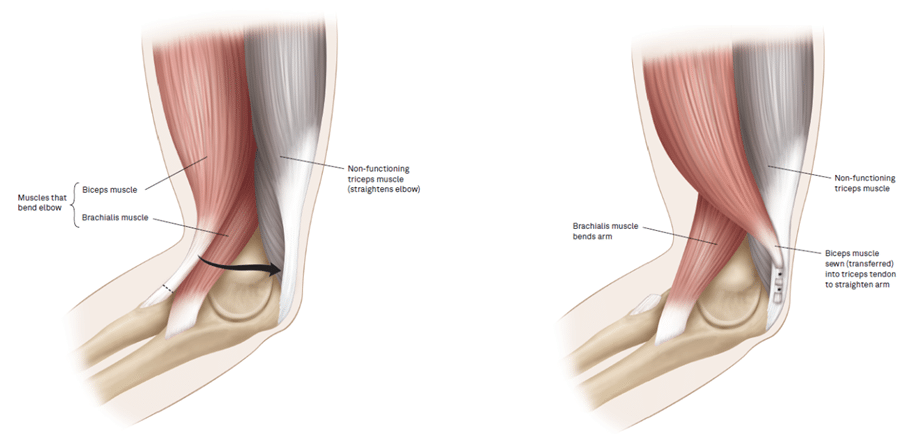
This is an example of tendon transfers surgery to borrow from elbow flexion, to restore the ability to extend the elbow in patients with spinal cord injuries
Conditions Tendon Transfer Treats
Tendon transfers may treat conditions such as:
- Nerve injuries that did not recover naturally
- Brachial plexus injuries
- Cervical spinal cord injuries
- Trauma affecting the muscles
- Some congenital conditions
Depending on your needs, surgery may improve wrist extension, finger flexion, grip, pinch, or elbow movement.
Tendon Transfer Candidates
This type of surgery may be right for you if:
- You have lost function in one or more parts of your upper limb
- You still have a good range of motion in the joints
- You have at least one working donor muscle
- You are committed to recovery and therapy
Dr. Janes has experience in all types of upper extremity reconstruction. She will explain whether tendon transfer, nerve transfer, or another approach is best for your unique situation.
What to Expect from Tendon Transfer Surgery
After a detailed evaluation and imaging, Dr. Janes recommends a personalized treatment plan tailored to your specific goals. The surgery typically involves a few small incisions in the arm or hand.
Dr. Janes uses specialized surgical approaches to perform this delicate surgery. In some cases, she may combine tendon transfer with other procedures like nerve transfer.
After surgery, you’ll wear a splint or cast for a short period to allow healing.
Physical therapy begins promptly after tendon transfer surgery and plays a crucial role in the recovery process. It teaches you how to activate the newly transferred tendon to create purposeful movement. Most people start noticing improvements within six to twelve weeks, with continued gains over time.
Benefits of Tendon Transfer
- Restores useful movement in the hand, wrist, or elbow
- Increases independence with eating, dressing, and hygiene
- Can improve strength and fine motor control
- Helps reduce the need for assistive devices
- Available even years after injury
Another potential advantage is that nerve transfer surgery is typically time-sensitive, but tendon transfer surgery is not.
FAQs
How does Dr. Janes decide which tendon to transfer?
Dr. Janes evaluates strength, joint flexibility, muscle balance, and overall limb coordination before selecting a donor tendon. The chosen tendon must provide enough strength to power the new movement without creating functional loss elsewhere. She also considers how well the surrounding joints move, since stiffness can limit the effectiveness of a transfer. Careful planning ensures the hand or arm remains balanced after reconstruction.
Will my hand feel natural after tendon transfer?
Movement often feels unfamiliar at first because the brain must relearn how to activate the transferred tendon. For example, a muscle that once performed one task may now control a completely different motion. With guided therapy and repetition, the brain adapts. Over time, most patients develop smooth, purposeful movement that feels intuitive during daily activities.
What happens if I have had my injury for many years?
Unlike nerve-based procedures, such as nerve transfer, tendon transfer can be effective even long after an injury. If the joints remain flexible and a healthy donor muscle is available, reconstruction may still restore useful movement. A detailed evaluation helps determine whether muscle strength and joint mobility support a successful outcome.
Can tendon transfer be combined with other reconstructive procedures?
Yes. In complex injuries, Dr. Janes may combine tendon transfer with other techniques to improve overall function. Staged reconstruction sometimes offers the best approach, especially in cases involving spinal cord injury or severe trauma. Treatment plans are individualized based on your goals and the condition of your tissues.
What are the risks or limitations of tendon transfer?
Possible risks include stiffness, tendon rupture, infection, or incomplete restoration of strength. In some cases, the transferred tendon may not provide full power for high-demand activities. Structured therapy and close follow-up reduce these risks and support long-term function.
How durable are the results over time?
When rehabilitation is completed and strength returns, tendon transfer results are typically long-lasting. Because the procedure relies on a working muscle rather than nerve regrowth, function does not depend on ongoing nerve recovery. Continued use and maintenance of joint flexibility help preserve outcomes.
Schedule Your Tendon Transfer Consultation
If an injury or illness has limited your arm or hand function, tendon transfer surgery may provide a solution. Call (312) 695-6022 to schedule a consultation with Dr. Lindsay E. Janes in Chicago, IL.